When people start looking for an affordable EEG headset, the comparison usually begins with a simple question: How many channels does it have?
That is useful, but it is not the whole story.
For DIY projects, STEM education, BCI development, research prototypes, and interactive applications, the more important question is often:
What can you actually do with the EEG data once you have it?
This is where BrainLink Pro becomes interesting. Compared with other consumer EEG headsets in a similar category, it takes a relatively straightforward approach: provide accessible EEG data, a wearable form factor, and a development path that allows users to move beyond a closed consumer experience.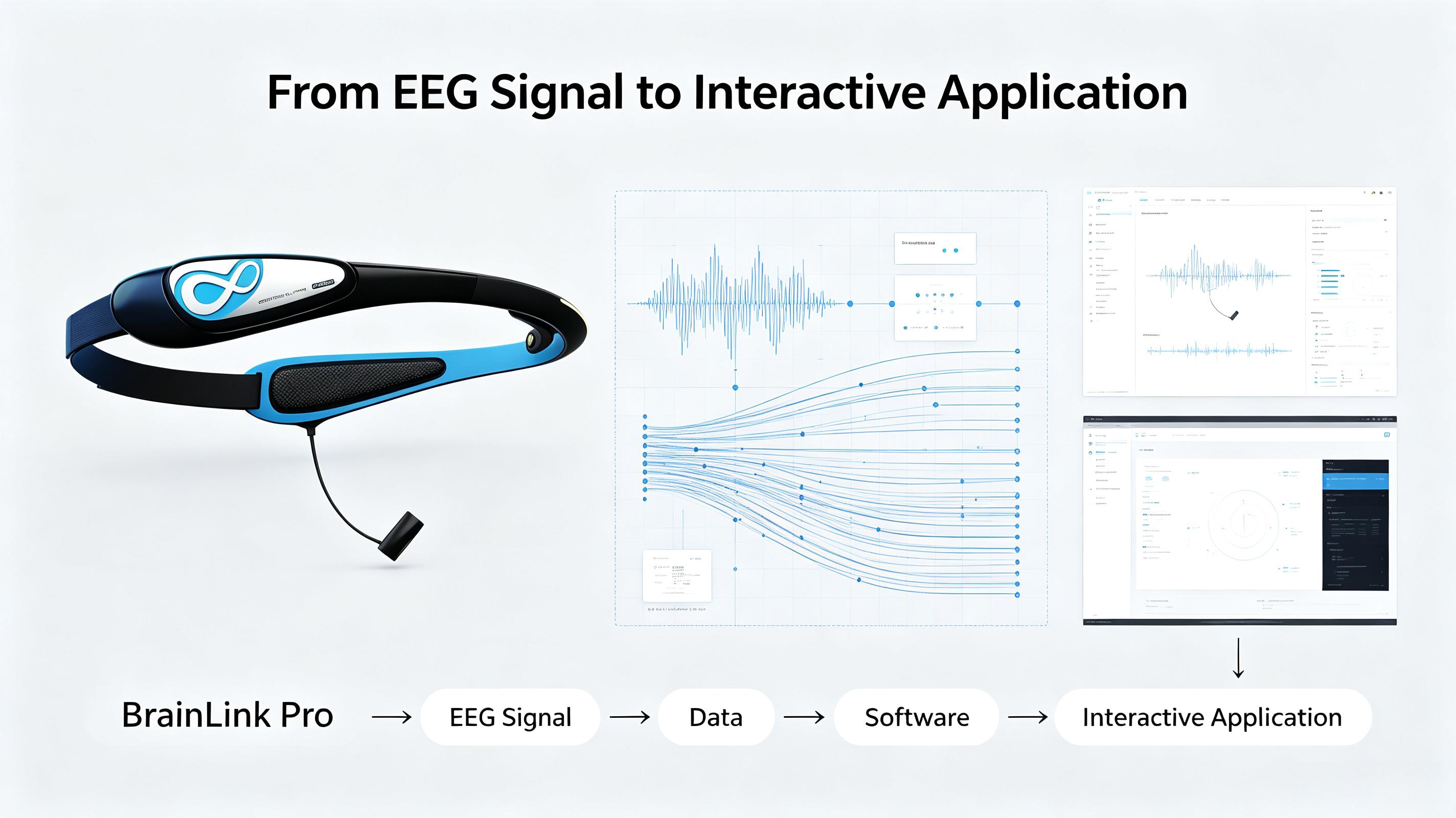
BrainLink Pro is often compared with products such as NeuroSky MindWave Mobile 2 and Muse 2 because they all bring EEG sensing into a portable, consumer-oriented form factor.
Their design philosophies, however, are different.
| Feature | BrainLink Pro | MindWave Mobile 2 | Muse 2 |
|---|---|---|---|
| EEG channels | 1 | 1 | 4 |
| Maximum sampling rate | Up to 512 Hz | 512 Hz | 256 Hz |
| Form factor | Adjustable headband | Headset with forehead sensor | Multi-sensor headband |
| Raw EEG | Available | Available | Available through supported tools |
| Wireless connection | Bluetooth | Bluetooth / BLE | Bluetooth |
| Main orientation | DIY, BCI, education, development | Education, apps, beginner EEG | Wellness, meditation, brain training |
| Development support | SDK / development tools | Developer tools | Development tools / ecosystem |
The specifications above are based on manufacturer information and published technical comparisons. A 2026 Scientific Reports study independently evaluated BrainLink Pro, MindWave Mobile 2 and Muse 2 alongside a research-grade EEG system, giving useful context for understanding how consumer EEG devices compare in real-world signal evaluation.
Muse 2 has four EEG channels, while BrainLink Pro and MindWave Mobile 2 use a single EEG channel.
At first glance, four channels may seem like the obvious choice.
But channel count should always be considered together with the intended application.
If your project is focused on learning the basics of EEG, exploring brainwave signals, building a simple BCI interaction, experimenting with neurofeedback concepts, or developing an educational project, a single-channel system can already provide a useful starting point.
In other words, more data is not necessarily more useful data.
A four-channel headset can provide a broader spatial picture of brain activity, but it may also introduce a different level of complexity in data interpretation and application development.
For many makers and developers, the question is not how much data a device can produce, but whether the available data is sufficient for the project they are trying to build.
One of the strongest reasons to consider BrainLink Pro is its position between a simple consumer gadget and a professional research EEG system.
It is not intended to replace a multi-channel research-grade EEG system. Instead, it offers an accessible platform for experimenting with EEG and BCI concepts without starting with the cost and complexity of laboratory equipment.
BrainLink Pro uses a single EEG channel at the Fp1 position with a reference electrode on the ear, and published testing reports a maximum sampling rate of 512 Hz.
The original BrainLink Pro design also emphasizes comfort, an adjustable headband, a rechargeable battery, and access to applications and developer tools. NeuroSky's documentation notes that BrainLink Pro can be used for app development and provides the same basic Bluetooth data types as the earlier MindWave platform.
That makes it particularly interesting for projects where the headset is not the final product, but part of the development process.
MindWave Mobile 2 is one of the closest comparisons because both devices use a single EEG channel and can provide raw EEG data.
NeuroSky lists a 512 Hz sampling rate, raw brainwave output, EEG power spectra, Bluetooth connectivity, and developer-oriented tools for MindWave Mobile 2.
The difference is therefore less about basic EEG capability and more about the overall hardware experience and product positioning.
BrainLink Pro was designed with an adjustable headband, rechargeable battery, and additional interactive features such as EmoLight. NeuroSky's own documentation specifically describes improvements in comfort and wearability compared with MindWave Mobile.
For someone building a project that requires repeated wearing, demonstrations, classroom activities, or interactive applications, these details can matter more than a specification sheet suggests.
Muse 2 takes a different approach.
It provides four EEG channels and combines EEG with other sensors for a more integrated consumer experience. Muse currently positions the product around focus, relaxation, meditation, and personal brain tracking, with a dedicated software ecosystem.
This makes Muse 2 attractive for users who want a polished, ready-to-use experience.
BrainLink Pro makes more sense when the goal is different:
You want to experiment. You want to build. You want access to the underlying signal and the flexibility to create your own application.
That distinction is important for educators, makers, developers, and companies working on prototypes.
The most interesting thing about an affordable EEG headset is not that it makes a person “read minds.”
It is that it makes experimentation possible.
A student can visualize EEG signals.
A maker can connect brainwave data to an interactive project.
A developer can experiment with BCI-based interfaces.
An educator can demonstrate how physiological signals can be measured and interpreted.
A product team can use a wearable EEG device as part of an early prototype.
This is where BrainLink Pro has a practical advantage: it provides a relatively accessible bridge between consumer electronics and biosignal development.
BrainLink Pro can be a good fit when your priority is:
It is less about having the largest number of electrodes and more about having a practical starting point for building something of your own.
There is no single EEG headset that is the right choice for every application.
Muse 2 is built around a broader multi-sensor consumer experience. MindWave Mobile 2 offers a simple and established single-channel EEG platform. BrainLink Pro sits closer to the maker, education, and development side of the market, combining accessible EEG acquisition with a wearable design and development possibilities.
For someone who wants to use an EEG headset, several products may work.
For someone who wants to learn from it, experiment with it, and build something with it, the more important question is not “Which headset has the most features?”
It is:
Which headset gives you the right starting point for what you want to create?
That is the space where BrainLink Pro continues to make sense.


