For a university project, STEM classroom, maker project, human-computer interaction prototype, or commercial BCI application, the priorities can be very different.
A headset that works well for meditation or consumer applications may not be the best choice for development. Likewise, a research-grade EEG system may offer more data than a small development project actually needs.
This guide explains the main factors to consider when choosing an EEG headset for BCI development and how to match the hardware with your project requirements.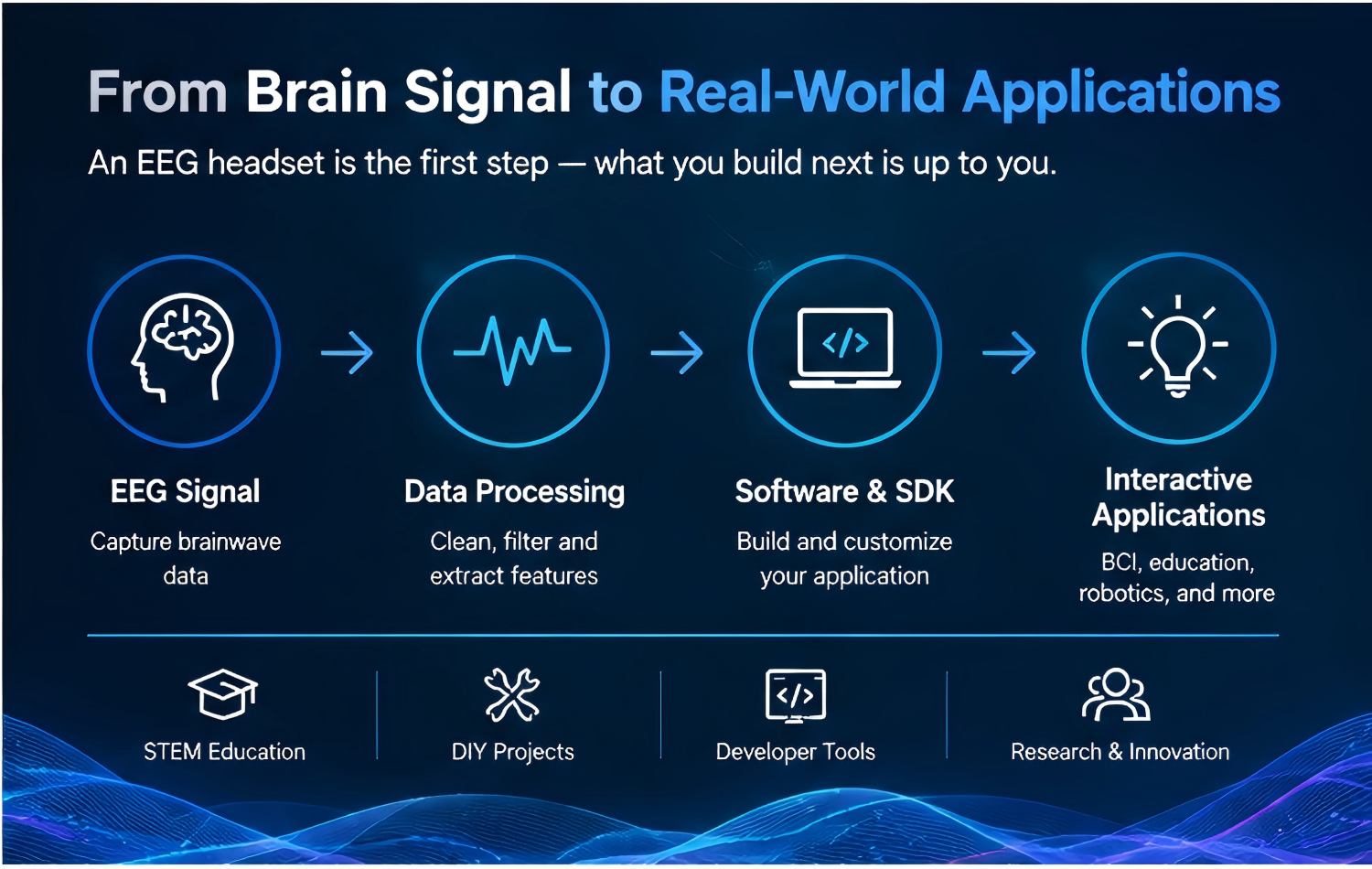
Before comparing products, it helps to separate an EEG headset into several basic components:
Not every specification has the same importance.
For example, a four-channel headset is not automatically a better development tool than a single-channel device. If your project only requires a particular EEG signal and your software can work with one channel, additional channels may add complexity without providing a meaningful advantage.
The first question should therefore be:
What do you actually want to build with the EEG data?
This is probably the most important step.
BCI development can mean very different things.
A student may want to build a simple brainwave visualization project. A maker may want to use EEG data to control an interactive device. A developer may be experimenting with human-computer interaction. A university laboratory may need more channels and greater control over signal acquisition.
These projects have different hardware requirements.
For a relatively simple project, a compact single-channel EEG headset may be enough to start collecting and processing EEG data.
For projects that require spatial information from different areas of the scalp, multiple EEG channels become much more important.
This is why channel count should be considered in relation to the application rather than viewed as a standalone quality indicator.
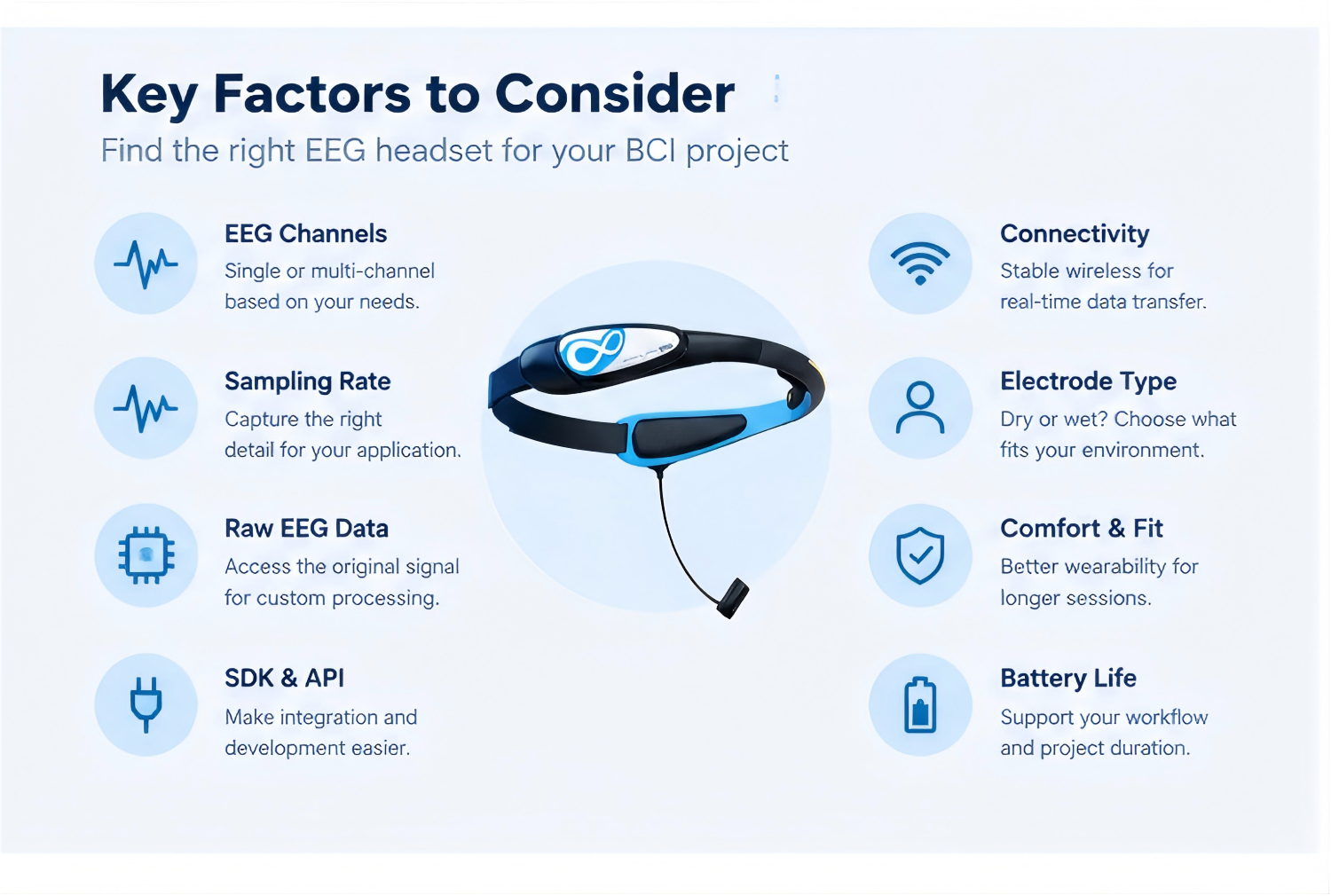
EEG channels determine how many electrical signals can be acquired from different electrode locations.
A single-channel EEG device can provide a relatively simple signal stream and may be easier to integrate into an entry-level development project.
Multi-channel EEG systems can capture signals from multiple locations simultaneously, which can provide more information for applications where electrode location matters.
However, more channels also mean:
For a developer building a proof-of-concept BCI, starting with a simpler EEG system can sometimes make the development process easier.
For more advanced signal analysis, multi-channel acquisition may be necessary.
1 channel:
Suitable for simpler experiments, educational projects and some single-signal applications.
2–4 channels:
Useful when a project needs signals from several electrode positions without moving immediately to a large research EEG system.
8+ channels:
More appropriate when spatial information and multi-location EEG analysis are important.
The exact requirement depends on the signal-processing method and application.
Sampling rate is another specification that often receives too much attention.
It describes how frequently the EEG signal is sampled.
A higher sampling rate can provide more temporal information, but that does not automatically mean the headset will produce better or more useful EEG data for every application.
When evaluating an EEG headset, consider the complete signal chain:
Electrode → Analog Front End → ADC → Sampling → Wireless Transmission → Software
A high sampling rate is useful only if the rest of the system can support the data properly.
You should therefore ask:
For many BCI development projects, understanding how the data is delivered is more important than simply looking for the largest sampling-rate number.
If you are buying an EEG headset for development, ask this before almost anything else:
Can I access the raw EEG data?
A consumer EEG product may provide only processed values such as attention, meditation or other calculated indicators.
Those values can be useful for certain applications, but they are not the same thing as having access to the underlying EEG signal.
For developers, raw EEG data can provide much more flexibility.
It allows you to work with your own:
This is particularly important if your goal is to develop your own BCI software rather than simply use an existing application.
Processed metrics
EEG → Device algorithm → Attention / meditation / other output
Raw EEG
EEG → Raw signal → Your software → Your algorithm → Your application
The second approach gives developers much greater control over the development process.
That does not mean raw data is always necessary. If you are simply building an educational demonstration, a processed output may be sufficient.
But if you are developing a BCI algorithm, raw data access should be one of the first specifications you check.
A headset can have excellent hardware and still be difficult to use if the development environment is poorly supported.
For BCI development, look beyond the product specification sheet.
Check whether the manufacturer or supplier provides:
This can make a significant difference to development time.
A developer who has to reverse-engineer a proprietary communication protocol may spend more time connecting the hardware than actually developing the BCI application.
Before placing an order, ask:
Can I access raw EEG data?
Is there an SDK or API?
Is the communication protocol documented?
Can the device work with my development platform?
Are programming examples available?
Can I receive continuous EEG data rather than only calculated brainwave metrics?
These questions are often more useful than simply asking whether a headset is “good for BCI.”
EEG is not simply about putting a headset on someone's head and receiving an identical signal every time.
Electrode position matters.
Different EEG locations can provide different signal information, and the appropriate placement depends on the application.
You should therefore check:
For a classroom or maker environment, ease of setup can be very important.
For a research-oriented application, electrode configuration and repeatability may matter more.
This is one reason why the physical design of the headset should be evaluated together with the electronics.
Electrode design can have a major effect on usability.
Wet electrodes use conductive material or gel to improve electrical contact.
Advantages can include good signal contact under appropriate conditions.
However, they can require:
Dry electrodes are designed to operate without conductive gel.
They can be much more convenient for:
But “dry” does not automatically mean “better.”
The actual electrode design, mechanical contact, hair interference, skin contact and signal acquisition electronics all affect performance.
For many development projects, the real question is:
Can I obtain sufficiently stable signals without making the setup unnecessarily complicated?
Most wearable EEG systems need some form of wireless communication.
Bluetooth and Bluetooth Low Energy are common approaches, but developers should look at the complete communication architecture.
Important questions include:
For a BCI prototype, unstable communication can become a bigger problem than the EEG hardware itself.
A useful development headset should make the path from headset → data → software reasonably straightforward.
This is easy to overlook when comparing specifications.
If the headset is uncomfortable, users may move their head frequently, adjust the electrodes, or stop using the system.
That can make repeated data collection more difficult.
For projects involving longer sessions, consider:
This is especially relevant for educational and interactive projects where different people may use the same device.
A development headset should not only produce data. It should also be practical enough to use repeatedly.
One common mistake is to treat EEG signal quality as a single number.
In practice, EEG is a low-amplitude biological signal and can be affected by many sources of interference.
For example:
This means a technically capable headset can still produce difficult data if the setup is poor.
For development work, it is useful to understand the basic signal chain and include appropriate preprocessing in your software.
A typical workflow might look like:
EEG acquisition → Signal quality check → Filtering → Artifact handling → Feature extraction → Classification → BCI application
The headset is only the first part of this process.
This distinction is important when choosing equipment.
Consumer EEG headsets are generally designed to be:
Research EEG systems may offer:
Neither category automatically replaces the other.
If you are building a small BCI prototype, an affordable development headset may be much more practical than purchasing a large research system.
If your project requires extensive multi-channel recording and advanced experimental control, a consumer headset may not provide enough flexibility.
The right question is not:
“Which EEG headset is the most advanced?”
It is:
“Which EEG system provides the data and control my project actually requires?”
The purchase price of the headset is only one part of the cost.
A realistic BCI development budget may include:
For a company developing a commercial product, supplier support can become particularly important.
A headset that is slightly more expensive but has clear documentation and accessible technical support may reduce development time.
For universities and STEM programs, availability of teaching materials and easy setup may be more important than advanced specifications.
The best EEG headset can also change as the project develops.
At this stage, the priority is:
The goal is to understand how EEG data behaves.
Now you may need:
The focus shifts from learning EEG to building something with it.
At this point, you may need:
For a commercial application, additional requirements may include:
This is where the relationship with the supplier becomes part of the hardware decision.
Before buying an EEG headset for BCI development, check these questions:
| Requirement | What to check |
|---|---|
| EEG channels | How many channels does the project actually require? |
| Sampling rate | Is the sampling rate appropriate for the application? |
| Raw EEG | Can you access the raw signal? |
| Electrodes | Dry or wet? Fixed or adjustable? |
| Reference | What reference and ground configuration are used? |
| SDK/API | Is development documentation available? |
| Data protocol | Is the data format documented? |
| Connectivity | Bluetooth, BLE, USB or another interface? |
| Compatibility | Windows, macOS, Android, iOS, etc. |
| Software | Are SDKs, libraries or examples available? |
| Comfort | Can users wear the device for the required period? |
| Support | Can the supplier provide technical assistance? |
| Supply | Is the product available for long-term projects? |
| Customization | Are OEM/ODM or hardware modifications possible? |
For developers looking for a compact EEG device that can bridge the gap between consumer electronics and hands-on BCI experimentation, BrainLink Pro is one example worth considering.
Its appeal is less about having the largest number of EEG channels and more about providing a relatively accessible platform for working with EEG and brainwave data.
Depending on the project, it can be considered for:
The important point is to evaluate the actual data access, communication method, software support and hardware configuration against your project requirements rather than choosing solely by product name.
If your project needs extensive multi-channel EEG acquisition, a larger research-oriented system may be more appropriate. If your goal is to start developing with EEG without the complexity of a laboratory system, a compact development headset can be a more practical starting point.
The terms are sometimes used interchangeably, but they can imply different priorities.
An EEG headset generally emphasizes the wearable hardware and user experience.
An EEG development kit places more emphasis on:
If you are a buyer searching for hardware for a BCI project, don't limit your search to “EEG headset.”
Search terms such as EEG development kit, EEG sensor, BCI development hardware, and raw EEG headset can lead to products designed with development in mind.
If you are purchasing EEG hardware for a university, company, laboratory, STEM program or commercial project, send the supplier a technical requirement rather than simply asking for a catalog.
For example:
We are looking for an EEG device for BCI development.
Required features:
– Raw EEG data access
– Wireless data transmission
– Development/API support
– Compatibility with our software environment
– Suitable for repeated testing
– Sample quantity: 5 units for initial evaluationPlease provide the technical datasheet, SDK/API documentation, communication protocol and available development examples.
This gives the supplier enough information to recommend an appropriate configuration.
It also helps you compare products on the things that actually matter to your project.
An EEG headset is only one part of a BCI system.
The complete development path is:
EEG Signal → Acquisition → Transmission → Processing → Algorithm → Application
A good headset for BCI development should fit naturally into that chain.
Before making a decision, identify the number of channels you need, determine whether raw EEG data is required, check the electrode configuration, confirm the sampling and communication specifications, and make sure the SDK or data protocol can support your development environment.
For education and simple prototypes, usability may be the deciding factor.
For software developers, raw data and API access may matter more.
For advanced research, channel configuration and acquisition flexibility may become the priority.
And for commercial projects, technical support, customization and long-term supply can be just as important as the hardware itself.
The best EEG headset is not necessarily the one with the longest specification sheet. It is the one that gives your project the right data, the right level of access, and a practical path from an EEG signal to a working application.
There is no single EEG headset that is suitable for every BCI project. The right choice depends on channel count, raw EEG access, electrode configuration, sampling rate, SDK/API support, connectivity and the requirements of the application.
If you plan to develop your own signal-processing or BCI algorithms, raw EEG access is usually an important requirement. If you only need predefined brainwave metrics for a simple application, raw data may not be necessary.
It depends on the application. Simple projects may work with a single channel, while applications requiring information from multiple scalp locations may require several channels or a larger EEG system.
Not necessarily. Sampling rate should be evaluated together with the acquisition electronics, signal quality, data access, wireless transmission and the requirements of your application.
An EEG headset is primarily a device for acquiring EEG signals. A BCI headset is generally discussed in the context of using those signals as an input for a brain-computer interface. The actual capabilities depend on the specific hardware and software.
Ask about raw EEG access, channel configuration, sampling rate, electrode type and placement, SDK/API availability, communication protocol, supported operating systems, development examples, technical support and long-term supply.


