A single-channel EEG device is an electroencephalography system designed to record one differential EEG signal from a selected measurement location, typically using an active electrode and a reference electrode. Compared with multi-channel EEG systems, a single-channel EEG device uses fewer sensing channels, which can make the system smaller, simpler to wear, easier to integrate, and more accessible for specific research, education, BCI, and development applications.
For international buyers, however, “one channel” does not automatically mean “basic” or “low quality.” The right question is whether the device provides the signal quality, electrode configuration, sampling performance, connectivity, software compatibility, and customization options required for the intended application.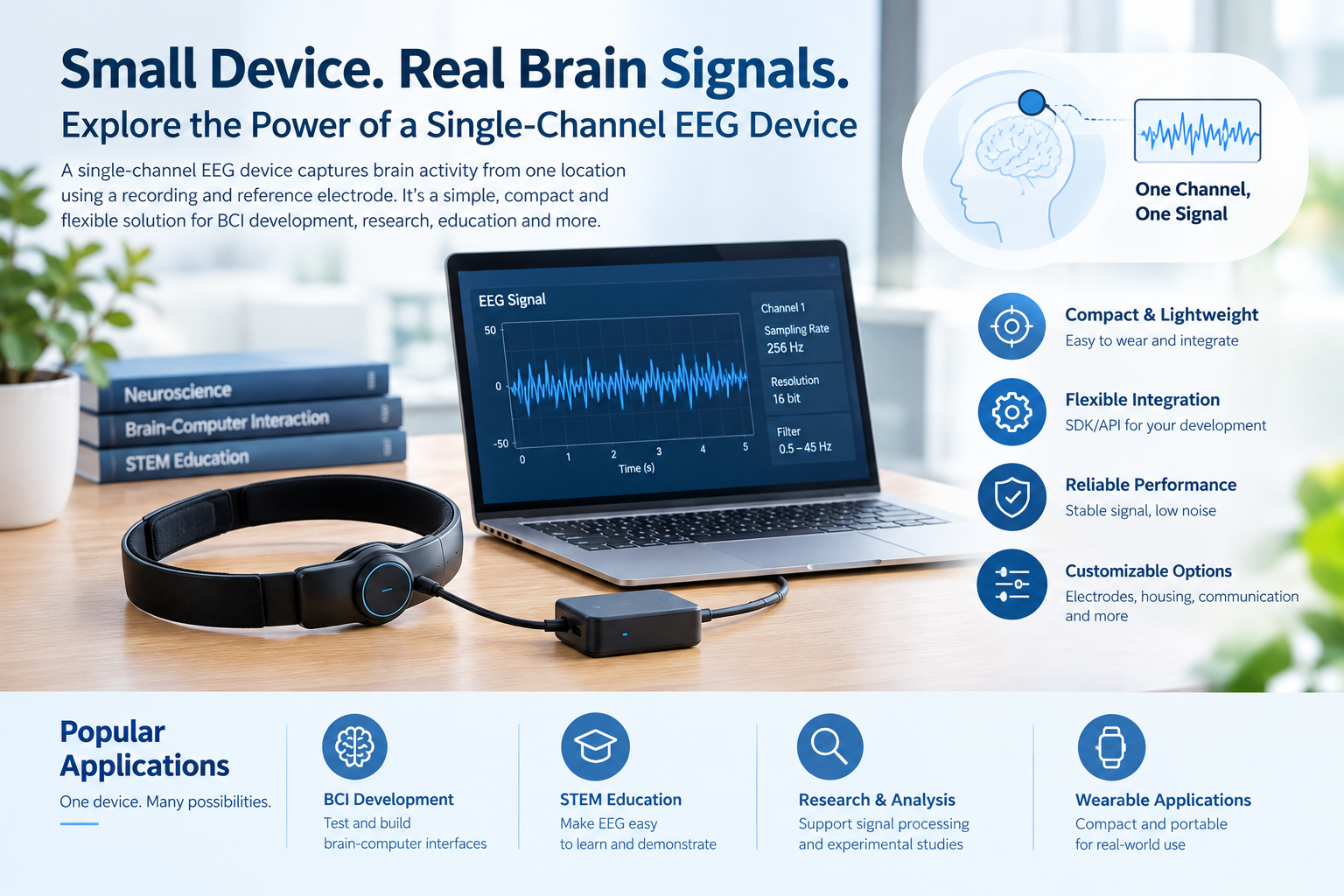
Key Takeaways
A single-channel EEG device can be a practical choice when the application focuses on one EEG measurement location or a relatively simple signal-processing task.
One EEG channel records a voltage difference between electrodes rather than simply measuring one electrode by itself.
Single-channel systems can be useful for BCI development, STEM education, EEG demonstrations, attention-related experiments, signal-processing projects, and wearable applications.
Fewer channels can reduce hardware complexity, size, setup time, and integration requirements.
A single-channel device is not equivalent to a full clinical EEG system. Clinical applications may require substantially more channels, specific hardware, software, safety, and regulatory compliance.
Buyers should evaluate electrode position, reference configuration, sampling rate, signal quality, connectivity, SDK/API availability, battery life, and intended-use classification rather than choosing purely by channel count.
For OEM, educational, and research projects, customization of electrodes, mechanical design, communication protocols, and accessories may be as important as the EEG amplifier itself.
What Is a Single-Channel EEG Device?
Understanding EEG in Simple Terms
Electroencephalography, or EEG, records electrical activity associated with brain activity using electrodes placed on or around the head. The U.S. National Library of Medicine describes EEG as the recording of electrical currents generated in the brain using electrodes.
One important point is often misunderstood: an EEG channel is not simply one electrode.
According to the EEG-BIDS specification, an electrode is a physical contact point, while a channel represents the recorded voltage difference produced by the acquisition system. In practical terms, one EEG channel normally involves a measurement electrode and a reference electrode, with the acquisition electronics measuring the difference between them.
Therefore, a single-channel EEG device may physically include:
One active or recording electrode
One reference electrode
A ground or bias connection, depending on the device architecture
An EEG amplifier
Analog-to-digital conversion
A communication interface
Battery and control electronics in a wearable device
Optional software or SDK for data access
What Does “Single Channel” Actually Measure?
A single-channel EEG system focuses on the electrical potential difference between a selected recording location and its reference.
For example, a wearable device may place its primary electrode around the Fp1 forehead position while using an ear reference. A recent evaluation of consumer-grade EEG devices identified both BrainLink Pro and MindWave Mobile 2 as single-channel systems using an Fp1 recording position and a reference electrode.
This configuration can be appropriate when the developer does not need simultaneous information from many areas of the scalp.
The trade-off is straightforward: one channel provides less spatial information than a multi-channel EEG system.
Single-Channel EEG vs. Multi-Channel EEG
Feature Single-Channel EEG Multi-Channel EEG
Recording channels 1 2, 4, 8, 16, 32, 64+ depending on system
Hardware complexity Lower Higher
Wearability Often easier Usually more complex
Setup Generally faster More electrodes and preparation
Spatial information Limited Greater
Data volume Lower Higher
BCI prototyping Suitable for selected applications Suitable for more complex paradigms
Education/STEM Very suitable Suitable but potentially more complex
Research flexibility Limited Higher
Cost and integration Often lower Usually higher
The standard clinical EEG setup is much more complex. For example, NCBI's EEG reference materials describe a standard adult EEG setup using 21 recording electrodes plus additional electrodes for ground and other measurements.
That comparison illustrates an important procurement principle: the correct channel count depends on the application, not simply on the assumption that more channels are always better.
How Does a Single-Channel EEG Device Work?
The electrode detects very small electrical potential changes at the measurement site. The amplifier then conditions and amplifies the signal before it is converted into digital data.
The quality of this first stage strongly affects everything that follows. A sophisticated algorithm cannot fully compensate for unstable electrode contact, excessive movement artifacts, electrical interference, or poor amplifier design.
The electrode configuration should be considered carefully when comparing products.
EEG systems may use:
NCBI's current instrumentation overview describes wet and dry electrode approaches as well as active and passive electrode architectures.
For wearable and educational products, dry electrodes can simplify setup because users do not need to apply conductive gel. However, electrode-skin contact and environmental noise remain important considerations.
After amplification and filtering, the analog EEG signal is converted into digital data.
This is where buyers should look beyond a headline specification such as “high sampling rate.” A higher sampling rate can be useful, but it does not by itself guarantee better EEG data.
When evaluating a device, consider:
Sampling rate
Resolution
Input-referred noise
Frequency response
Filtering
Signal-to-noise performance
Electrode impedance/contact behavior
Data transmission stability
A modern single-channel EEG headset may transmit data through Bluetooth, USB, or another digital interface.
For B2B buyers, software compatibility can become a decisive factor. A device that provides accessible raw or processed data, documentation, and an SDK/API can be much easier to integrate into an existing application than a closed device.
This is particularly relevant for BCI development, educational software, interactive installations, research prototypes, and custom hardware projects.
Single-Channel EEG Device Applications
A single-channel EEG device is most useful when the application does not require extensive spatial mapping of brain activity.
BCI Development and Prototyping
Brain-computer interfaces use recorded brain signals as an input for computer or machine interaction. A typical EEG-based BCI involves signal acquisition, preprocessing, feature extraction/classification, and an output or feedback system.
For early-stage BCI development, a single-channel EEG device can be useful for:
It is important to distinguish prototype development from applications that require high spatial resolution or clinical-grade EEG acquisition.
STEM and Neuroscience Education
Single-channel EEG devices can also be useful in education because they reduce the complexity of demonstrating EEG.
A classroom, university laboratory, or STEM program may want students to understand:
What EEG signals look like
How electrodes acquire biological signals
How signal noise affects measurements
How digital signal processing works
How EEG can provide an input for an interactive system
A compact one-channel system can make these concepts easier to demonstrate without requiring a complete clinical EEG setup.
Research and Signal-Processing Projects
Consumer-grade EEG devices are already used across research categories including BCI, experimental research, validation, and signal processing. A scoping review identified these as recurring research uses for consumer EEG devices.
For research teams, the critical issue is not simply whether a device has one channel. Researchers should confirm whether the device provides the raw data access, sampling characteristics, electrode placement, synchronization, and documentation required by their experimental design.
Wearable and Portable Applications
One reason single-channel EEG remains attractive is its potential for compact wearable designs.
Wearable EEG research continues to focus on improving signal acquisition while reducing system size, wiring, setup complexity, and user burden.
For product developers, this creates opportunities for:
For buyers developing a wearable EEG product, it is worth evaluating the complete acquisition chain—not just the headset. Electrode type, reference location, mechanical stability, wireless transmission, and software integration can all affect the final user experience.
How to Choose a Single-Channel EEG Device for B2B Projects
Before comparing specifications, define what the device needs to accomplish.
Ask:
A clear application definition can prevent buyers from paying for capabilities they do not need.
The electrode position can be more important than the marketing description.
Ask the supplier for the exact recording and reference locations and confirm whether they correspond to the requirements of your application.
Standardized electrode placement systems such as the 10–20 system provide a common framework for identifying scalp positions. IFCN materials also describe broader 10–10 and 10–5 systems for applications requiring higher electrode density.
Request a complete technical specification rather than relying on a single number.
Useful parameters include:
For example, a 2026 comparative evaluation reported a maximum sampling rate of 512 Hz for both BrainLink Pro and MindWave Mobile 2, while different multi-channel devices had different sampling specifications.
The key lesson is that specifications should be evaluated as a system, not individually.
For B2B buyers, hardware is only one part of the project.
Check whether the supplier provides:
These details can significantly reduce development time.
This point is especially important for international procurement.
IEC 80601-2-26:2019, with its 2024 amendment, specifies requirements for the basic safety and essential performance of electroencephalographs used in professional healthcare, emergency medical services, and home healthcare environments.
That does not mean every consumer, educational, research, or BCI-development EEG device automatically falls under the same regulatory requirements. Classification depends on the product's intended use and the applicable jurisdiction.
For B2B sourcing, buyers should therefore ask suppliers to clearly define:
Do not select a product first and investigate regulatory requirements later.
A single-channel EEG platform can become more valuable when the supplier can adapt it to a specific application.
Potential customization areas include:
For example, a developer may already have software but need a compact EEG acquisition module and a customized dry-electrode assembly. Another buyer may need an educational headset with a simplified mechanical structure and wireless data transmission.
In both cases, the supplier's engineering and customization capability can matter as much as the standard product specification.
When Should You Choose a Single-Channel EEG Device?
A single-channel EEG device can be a practical choice when the project prioritizes simplicity, portability, cost control, and focused signal acquisition.
It may be suitable for:
STEM and neuroscience education
BCI prototyping
EEG signal-processing development
Interactive technology projects
Wearable EEG product development
Research pilots
Consumer electronics integration
OEM/ODM development
However, a single channel may not be appropriate when the project requires extensive spatial information across the scalp.
For example, IFCN guidance describes 10–20 systems with multiple electrodes for sensor-level EEG analysis and higher-density 10–10 and 10–5 configurations for applications requiring more detailed spatial information.
The decision should therefore follow the research or product requirement rather than the assumption that a higher channel count is always preferable.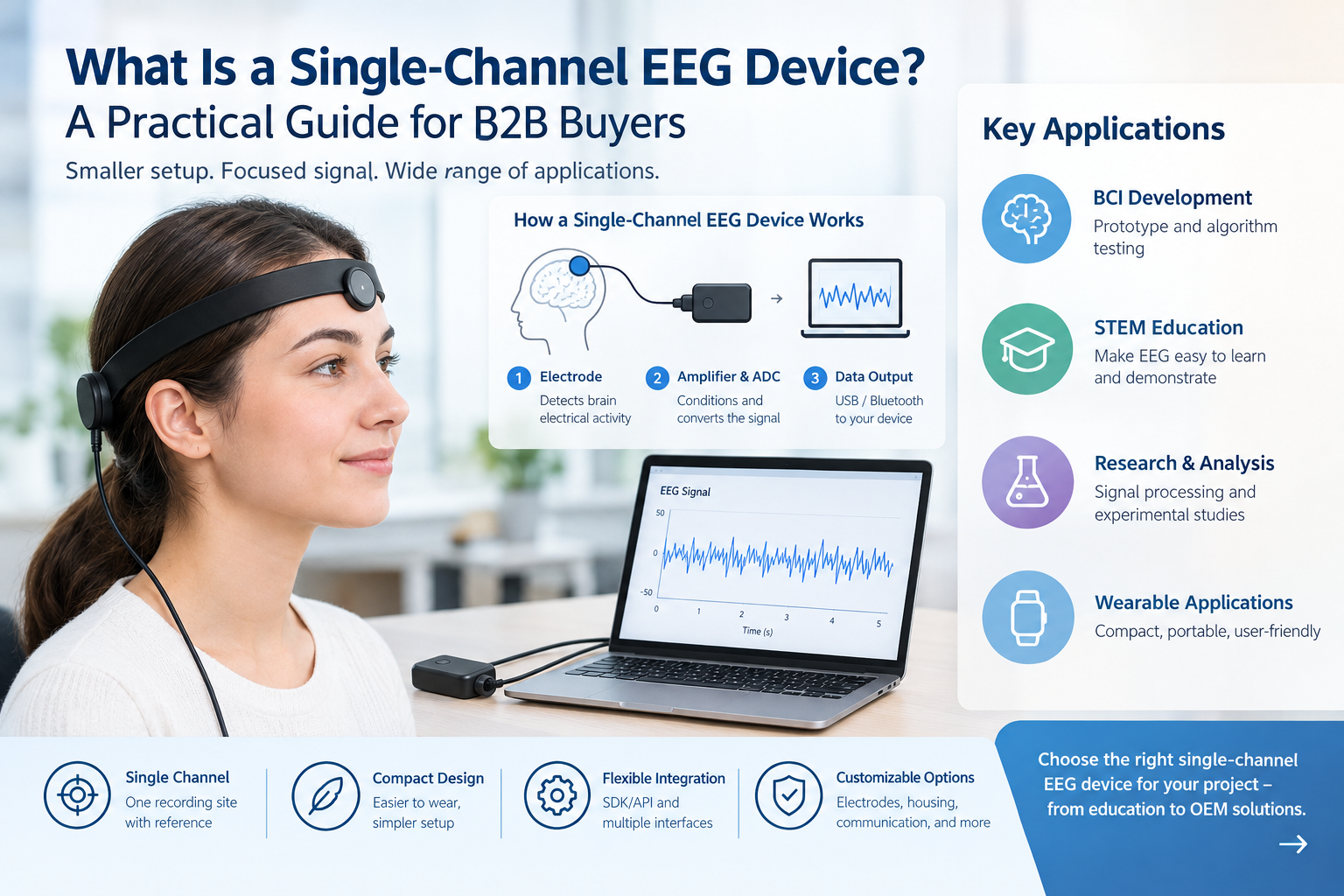
A Practical B2B Decision Checklist
Before placing an order, ask the supplier for:
Hardware
Exact channel configuration
Recording and reference electrode locations
Electrode type and material
Sampling rate
ADC resolution
Frequency response
Noise specifications
Software
Raw-data access
SDK/API
Supported operating systems
Communication protocol
Data format
Sample applications
Commercial
MOQ
Sample availability
Lead time
Warranty
Spare electrodes and cables
OEM/ODM options
Private-label packaging
Technical support
Compliance
Intended-use statement
Available test reports
Applicable certifications
Target-market documentation
This checklist helps procurement teams compare suppliers on measurable requirements instead of comparing product pages alone.
If your project needs a compact EEG solution for education, BCI development, research, or OEM integration, a supplier should be able to provide both the device specifications and the electrode/accessory options needed for your application.
Frequently Asked Questions About Single-Channel EEG Devices
Is a single-channel EEG device real EEG?
Yes. A single-channel EEG system can record an EEG voltage difference using a recording electrode and reference configuration. However, one channel provides substantially less spatial information than a multi-channel EEG system. The distinction is primarily about the amount and location of simultaneously recorded information, not whether the signal is “real” EEG.
What is the difference between a single-channel EEG headset and a multi-channel EEG headset?
The main difference is the number of simultaneously acquired EEG channels. A single-channel EEG headset generally focuses on one recording configuration, while multi-channel systems collect signals from multiple locations.
Multi-channel systems provide more spatial information but usually require more electrodes, more electronics, greater data handling, and more complex setup.
Can a single-channel EEG device be used for BCI?
Yes. Single-channel EEG can be used for certain BCI prototypes and applications, particularly where the selected signal is sufficient for the intended task.
However, BCI performance depends on much more than channel count. Electrode placement, signal quality, preprocessing, feature extraction, classification, user variability, and experimental design all influence the result.
Is a single-channel EEG device suitable for medical use?
Not necessarily. A device's channel count does not determine whether it is a medical device.
Medical use depends on the manufacturer's intended purpose, product design, applicable regulations, and required safety and performance standards. IEC 80601-2-26 specifically addresses electroencephalographs used in defined healthcare environments.
Buyers should verify the regulatory status and intended use with the manufacturer before using or marketing an EEG product for healthcare purposes.
What should I ask an EEG supplier before buying?
At minimum, ask about electrode configuration, reference location, sampling rate, signal specifications, raw-data access, SDK/API, connectivity, certifications, intended use, MOQ, and customization options.
For OEM or research projects, also request a sample unit and technical documentation before committing to a larger order.
Final CTA
Choosing a single-channel EEG device is not simply a matter of selecting the lowest price or the highest sampling rate. The right solution should match your application, electrode configuration, signal requirements, software environment, regulatory needs, and future product plans.
If you are sourcing single-channel EEG devices, dry EEG electrodes, EEG cables, acquisition accessories, or customized EEG solutions for research, STEM education, BCI development, or OEM projects, request the technical specifications and available customization options before making your purchasing decision. A detailed supplier evaluation at the beginning can save substantial development time later.


