For STEM education, the value of an EEG headset is not simply in displaying brainwave data. It is in giving students a real scientific tool to ask questions, collect data, build experiments, and understand how technology can connect the human brain with computers and other devices.
What Is an EEG Headset?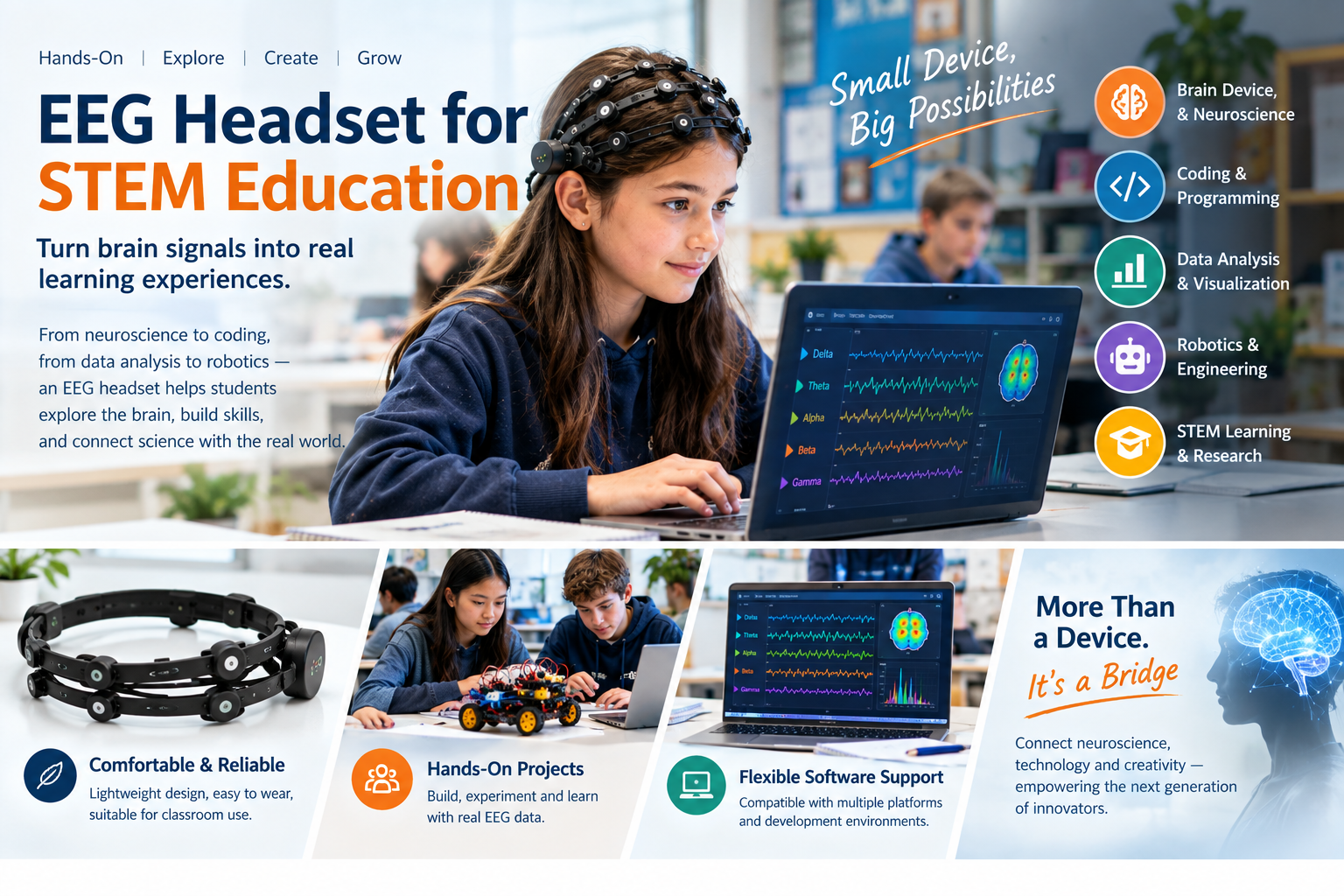
An EEG headset is a wearable device designed to record electrical activity from the brain through electrodes placed on the scalp. EEG, short for electroencephalography, measures small changes in electrical potential associated with brain activity.
Unlike an ordinary educational demonstration that uses a diagram or prerecorded video, an EEG activity can give students access to real-time physiological data. Depending on the headset and software, students may be able to observe raw EEG signals, frequency-band information, or processed metrics used in a particular educational or research application.
This makes EEG especially interesting for interdisciplinary STEM teaching.
A single classroom project can involve several subjects at once:
Biology: How does the brain produce measurable electrical activity?
Neuroscience: What are EEG signals and frequency bands?
Physics: How are small electrical signals detected and measured?
Computer science: How can signal data be collected, processed, and visualized?
Engineering: How can a wearable device interact with a computer or robot?
Mathematics: How can students analyze patterns and variations in data?
That combination is one of the reasons EEG has attracted attention in STEM education and educational research.
Why Use EEG in STEM Education?
Traditional STEM lessons often explain scientific concepts first and demonstrate them afterward. EEG can reverse that process.
Students can begin with a question:
What happens to EEG signals when I perform different tasks?
They can then collect data, compare results, look for patterns, discuss limitations, and develop their own explanations.
This turns the lesson from simply learning about neuroscience into a small scientific investigation.
The BrainWaves program developed by the University of Connecticut and NYU, for example, brought portable EEG technology into high-school STEM classrooms and used it as part of a research-oriented curriculum. The program combined curriculum development, teacher training, mentoring, and student research, and reported improvements in research self-efficacy and college readiness among participating students.
The important point is that the headset itself is not the lesson. The experiment is the lesson.
EEG Headsets and Hands-On Neuroscience
Neuroscience can be difficult to teach because much of what happens inside the brain cannot be directly observed.
An EEG headset provides a different starting point.
Students can wear the device, observe a signal, and then investigate how that signal changes under different experimental conditions. Even a simple classroom activity can introduce concepts such as electrical signals, electrodes, sampling, noise, filtering, frequency, and data visualization.
For younger students, the activity can focus on observation and basic scientific questions.
For older students, the same hardware can become a starting point for more advanced work involving:
EEG signal acquisition
Signal processing
Frequency analysis
Data visualization
Python or other programming environments
Machine learning
Brain-computer interfaces
Human-computer interaction
Experimental design
This makes an EEG headset suitable for a range of STEM learning levels rather than a single type of classroom.
EEG and Brain-Computer Interface Projects
One of the most engaging ways to introduce EEG in STEM education is through a brain-computer interface project.
A BCI uses brain-related signals as an input for a computer system. In EEG-based BCI projects, students can learn how signals are acquired and processed before being translated into information that software can use.
For example, an educational project might involve:
EEG headset → signal acquisition → data processing → software → visual or interactive output
The project does not have to begin with a complicated robotic system.
Students can start by visualizing EEG signals on a computer and gradually move toward more advanced applications. Depending on the hardware and software available, projects may involve interactive programs, simple games, digital interfaces, or robotics.
Recent research reviews have identified robotics and engineering practice as one of the major areas where EEG-based BCIs are being explored in STEM learning, alongside attention and engagement monitoring, neurofeedback, and affective learning.
This gives teachers an opportunity to connect neuroscience with subjects students may already know, including coding, robotics, electronics, and engineering.
Possible Classroom Activities
An EEG headset does not need to be used for a complicated research project to be educationally useful.
Students can first learn what an EEG signal looks like.
They can observe how the recorded signal changes over time and discuss why real-world biological signals are not perfectly clean or stable.
This provides a natural introduction to measurement error and signal noise.
Students can design a simple experiment comparing EEG recordings under different tasks.
The objective should be to learn how experiments are designed and how data should be interpreted, rather than assuming that one EEG pattern automatically represents a specific mental state.
Students can record observations, organize the data, compare conditions, and discuss possible explanations.
For advanced STEM classes, EEG provides a useful real-world example of digital signal processing.
Students can explore concepts such as:
Sampling rate
Filtering
Noise
Frequency
Spectral analysis
Data visualization
Instead of learning these concepts only from textbook examples, students can work with an actual biological signal.
Students with programming experience can use EEG data as an input for a software project.
A simple project might visualize selected EEG features or use predefined signal characteristics to trigger an interaction.
The focus can then shift from “What does this signal mean?” to a broader engineering question:
How can we turn biological data into a useful computer input?
EEG becomes particularly interesting when combined with robotics.
Students can explore the basic architecture of a system in which EEG data is acquired, processed, and used as an input for a robot or other electronic device.
This connects biology, electronics, programming, data science, and engineering in one project.
EEG for Different Levels of STEM Education
Elementary and Middle School
For younger learners, EEG activities should remain visual, practical, and easy to understand.
The objective can simply be to introduce the idea that the brain produces measurable electrical signals and that scientists can use technology to record them.
At this level, demonstrations, guided experiments, simple data visualization, and introductory brain-computer interface activities can work well.
High School
High-school students can go further into experimental design and data analysis.
Possible topics include:
Brain anatomy and physiology
EEG electrodes
Electrical signals
Frequency bands
Signal noise
Data collection
Basic programming
BCI concepts
Scientific reporting
A research-style project can ask students to form a hypothesis, collect data, analyze results, and explain limitations.
This approach is consistent with existing classroom EEG programs that use portable EEG equipment to give students experience with authentic research.
University and Advanced Programs
At university level, EEG headsets can support more specialized projects in neuroscience, biomedical engineering, computer science, psychology, human-computer interaction, and BCI research.
Depending on the device and research requirements, students may work with raw EEG data, signal-processing pipelines, classification algorithms, or interactive BCI systems.
Portable EEG is particularly useful when the educational objective requires data collection outside a traditional laboratory. Recent research has demonstrated the feasibility of wearable EEG collection in real classroom environments, including longitudinal studies involving large numbers of recordings.
What Should You Look for in an EEG Headset for Education?
Not every EEG headset is designed for the same purpose.
When choosing an EEG headset for a STEM classroom, it is useful to look beyond the number of electrodes.
Ease of Setup
A classroom device needs to be practical. If students spend most of the lesson preparing equipment, there is less time for experimentation.
Consider how the headset is worn, how electrodes are positioned, how signals are acquired, and how quickly students can begin an activity.
Data Access
For introductory education, processed information may be sufficient.
For programming, engineering, and research-oriented projects, access to EEG data can be much more important.
Teachers should therefore check what type of data the device provides and whether the data can be accessed by external software.
Software Compatibility
An EEG headset becomes more useful for STEM education when it can work within different learning environments.
Depending on the project, compatibility with visualization software, development environments, APIs, SDKs, or other educational tools may be important.
Portability
Portable EEG equipment can make it easier to move activities between classrooms, laboratories, workshops, and demonstrations.
This is one reason wearable EEG systems have increasingly been explored for educational research outside traditional laboratory settings.
Electrode Design
Electrode type can affect setup, comfort, signal quality, and classroom practicality.
Depending on the headset, systems may use dry electrodes, wet electrodes, or other electrode configurations.
There is no single electrode design that is ideal for every application. The appropriate choice depends on the intended experiment, recording environment, and required data quality.
EEG Data Is Not a Magic Window Into the Brain
This is an important point for both teachers and students.
An EEG headset records electrical activity measured at the scalp. The resulting signal is influenced by many factors, including electrode contact, movement, environmental interference, and physiological signals such as muscle activity.
A change in an EEG signal should therefore not automatically be interpreted as proof that a student is “focused,” “smart,” “happy,” or experiencing a particular mental state.
Portable EEG can be valuable for educational experiments and research, but its limitations need to be part of the lesson.
A review of portable EEG in educational research has highlighted issues including measurement error and the importance of combining EEG information with other forms of evidence rather than relying on brainwave data alone.
That limitation is not a weakness of STEM education. In fact, it can become part of the learning experience.
Students can ask:
Is our measurement reliable?
What could have affected the signal?
How would we improve the experiment?
These are exactly the kinds of questions that good scientific training should encourage.
Privacy and Responsible Use of EEG in Schools
EEG education also introduces an important discussion about data ethics.
Brain-related data should be handled carefully, particularly when students are involved. Schools and educators should establish appropriate procedures for consent, data storage, access, and use before collecting EEG data.
Educational demonstrations should not turn EEG into a tool for labeling students or making unsupported judgments about their abilities, emotions, attention, or personality.
The most useful role for an EEG headset in STEM education is to support learning, experimentation, and scientific inquiry.
Students should learn not only how to collect data, but also how to question it.
From Brain Science to STEM Skills
The strongest reason to introduce EEG into STEM education is not that it looks futuristic.
It is because EEG creates a real engineering and scientific problem for students to work on.
A student can begin with a question about the brain and end up learning about electronics, programming, statistics, signal processing, experimental design, and data interpretation.
That is the strength of interdisciplinary STEM learning.
An EEG headset can become:
a neuroscience tool for biology students,
a signal source for engineering students,
a dataset for computer science students,
an experimental platform for researchers,
and a starting point for BCI projects and maker activities.
Recent reviews of EEG-based BCI applications in education show growing interest in combining neuroscience with robotics, engineering, computing, and adaptive learning technologies. At the same time, researchers continue to identify signal quality, calibration, interpretation, and ethics as important challenges.
That balance matters.
The goal is not to make the classroom look like a laboratory of the future.
The goal is to give students a real problem, real data, and the opportunity to figure out what the data can — and cannot — tell them.
Choosing the Right EEG Headset for Your STEM Program
Before purchasing an EEG headset for a school, laboratory, maker program, or educational project, consider the entire learning workflow:
Who will use it?
What will students actually measure?
Will they need raw EEG data or only processed information?
What software will they use?
How much classroom time is available for setup?
Will the project involve programming or BCI development?
How will EEG data be stored and handled?
The right headset is therefore not necessarily the one with the most features. It is the one that fits the educational objective and the technical level of the students.
For a simple neuroscience demonstration, ease of use may matter most.
For a university BCI course, data access and development support may be more important.
For a maker or engineering program, software compatibility and integration possibilities may become the deciding factors.
Final Thoughts
EEG technology gives STEM education something that textbooks cannot provide on their own: an opportunity for students to work with a real biological signal.
They can observe it, question it, analyze it, and build technology around it.
That makes an EEG headset more than a wearable device. Used thoughtfully, it can become a bridge between neuroscience and the practical skills of modern STEM education.
For schools, universities, laboratories, STEM programs, and educational technology developers, EEG provides a hands-on way to introduce students to one of the most interesting intersections of biology, engineering, data, and computing: the connection between the human brain and technology.
Frequently Asked Questions
Can EEG headsets be used in STEM education?
Yes. Portable EEG systems have been used in educational research and classroom-oriented STEM programs, including hands-on neuroscience and BCI activities.
What can students learn from an EEG headset?
Depending on their level and the equipment available, students can learn about neuroscience, EEG signals, electrodes, signal processing, data analysis, programming, experimental design, and brain-computer interfaces.
Are EEG headsets suitable for classroom use?
Portable EEG systems can be suitable for classroom activities when the device, software, experiment design, and data-handling procedures are appropriate for the educational setting. Signal quality and measurement limitations should be considered.
Can EEG be used for BCI education?
Yes. EEG is one of the main signal acquisition methods used in non-invasive BCI systems. Educational BCI projects can introduce students to the process of acquiring, processing, and interpreting brain-related signals.
Does an EEG headset measure thoughts directly?
No. EEG records electrical activity measured at the scalp. Interpreting EEG data requires appropriate signal processing and experimental context. A headset should not be presented as a device that directly “reads thoughts.”


